
Understanding the Patient File
Understanding the Patient File
What: Every patient file is organised into a left-hand menu of sections, Overview & timeline, Account & medical aid, General screening, Conditions & medication, Lifestyle & family, Surgical & hospitalisation, Allergies, Vitals & metrics (or the age/sex-specific equivalents below), and Vaccination schedule.
Why: Knowing where each piece of information lives means you spend less time hunting during a consultation and more time with the patient.
When: Any time you open a patient's file, this menu is always available in the same place, whether you're preparing for a consult or reviewing history afterwards.
Sections
Shown below on Anaya Nkosi, a 12-year-old patient, her file happens to display every age/sex-specific section variant (Growth charts, Developmental screening, Gynae) alongside the standard ones, so one patient demonstrates almost the entire menu.
1. Overview & timeline
Location: Patient file › left menu (default section)
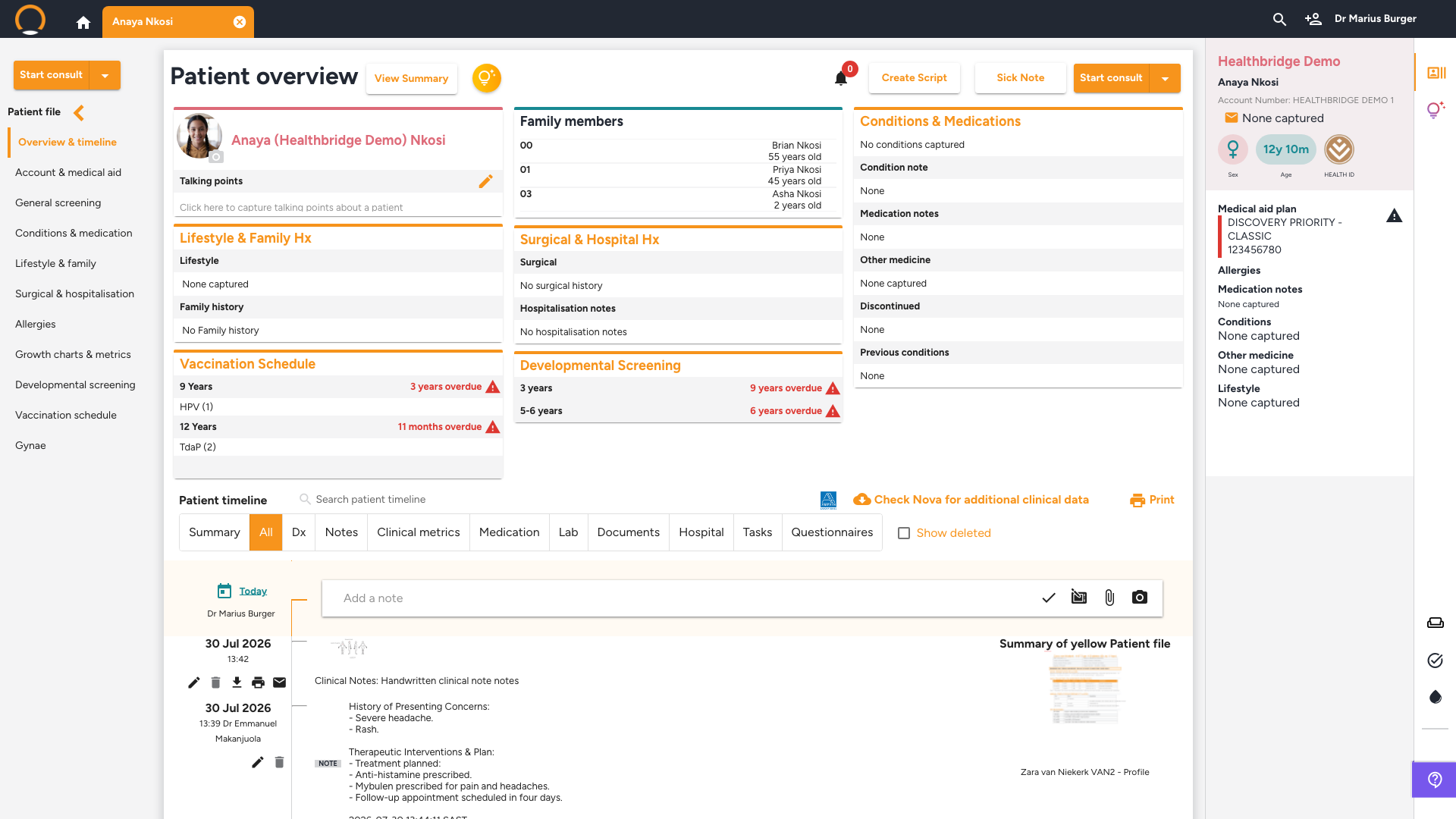
The default view when you open a patient's file. It gives you a quick summary at a glance: patient details, current Conditions & Medications, a Lifestyle/Family Hx summary, Surgical & Hospital Hx, linked Family members, and the full Patient timeline below, every note, pathology result, and uploaded document, in order.
2. Account & medical aid
Location: Patient file › left menu
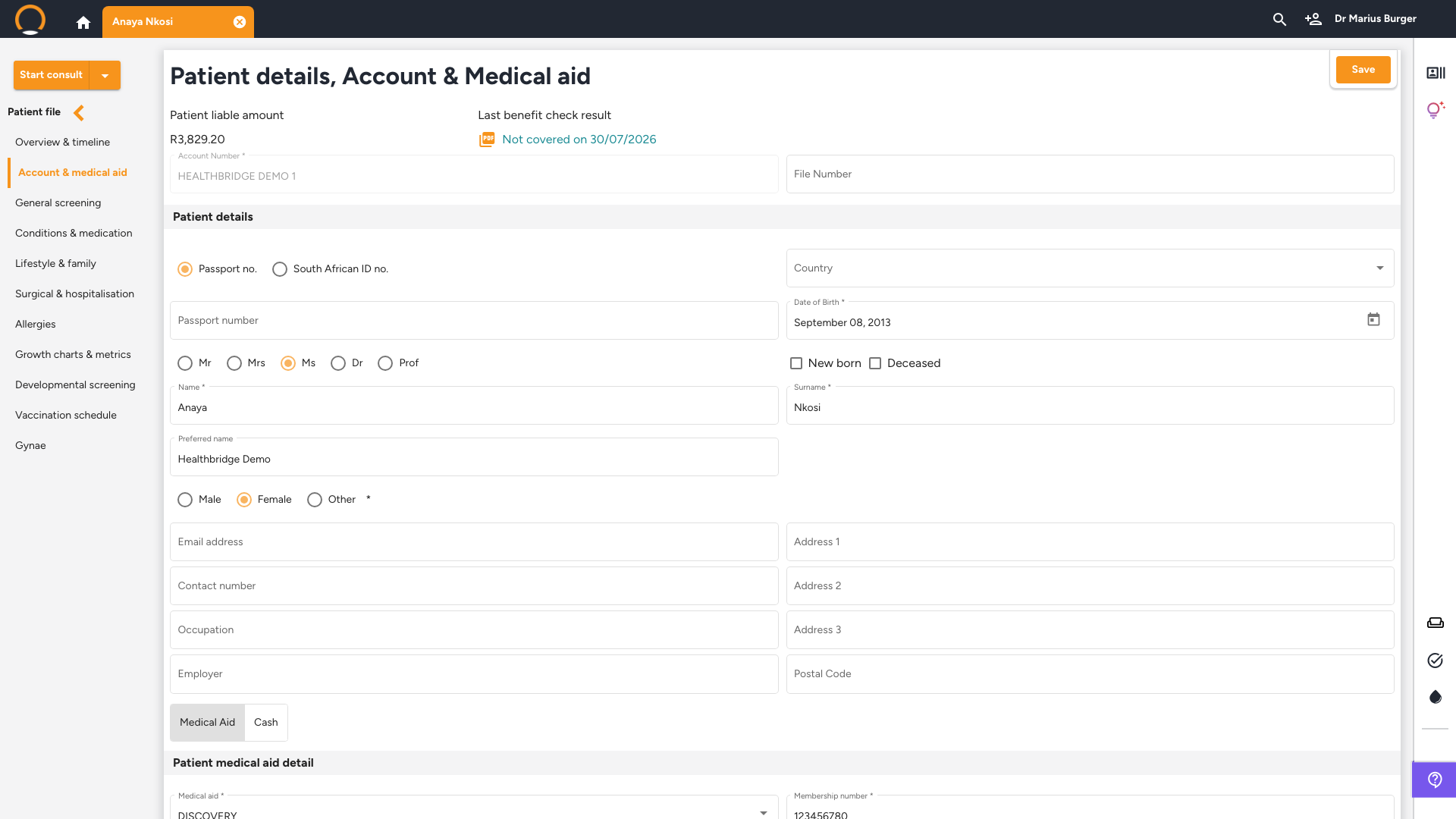
The patient's demographic and billing details: contact information, medical aid scheme and membership number, and the Patient liable amount, any outstanding balance owed by the patient or account holder.
3. General screening
Location: Patient file › left menu
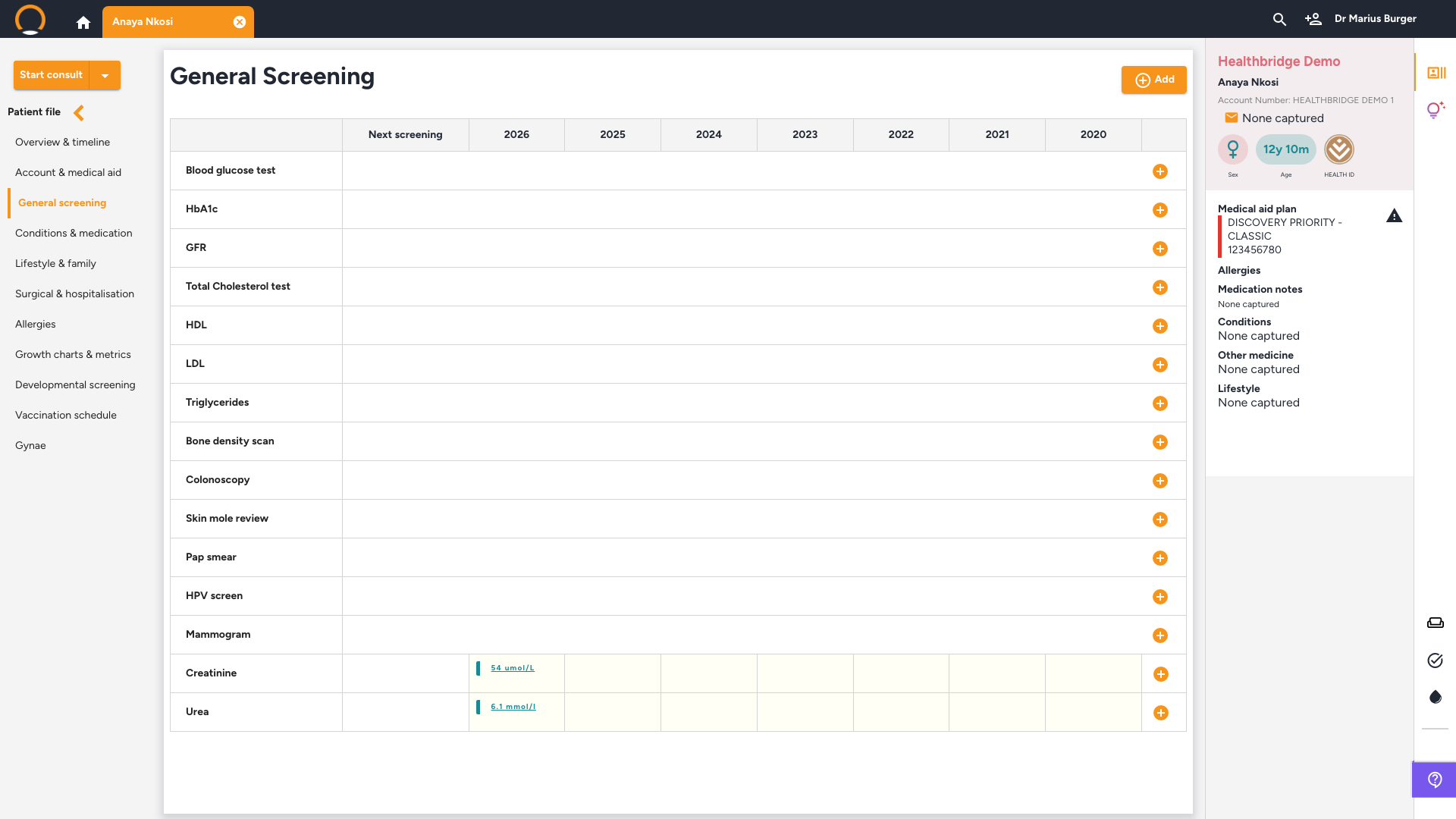
A year-by-year grid of screening tests, blood glucose, cholesterol, colonoscopy, and more, so you can see results and trends over time at a glance. Click the + at the end of a row to add a result for that test. If the test you need isn't listed, click '+ Add' to select it, or add a fully custom test/metric to track.
4. Conditions & medication
Location: Patient file › left menu
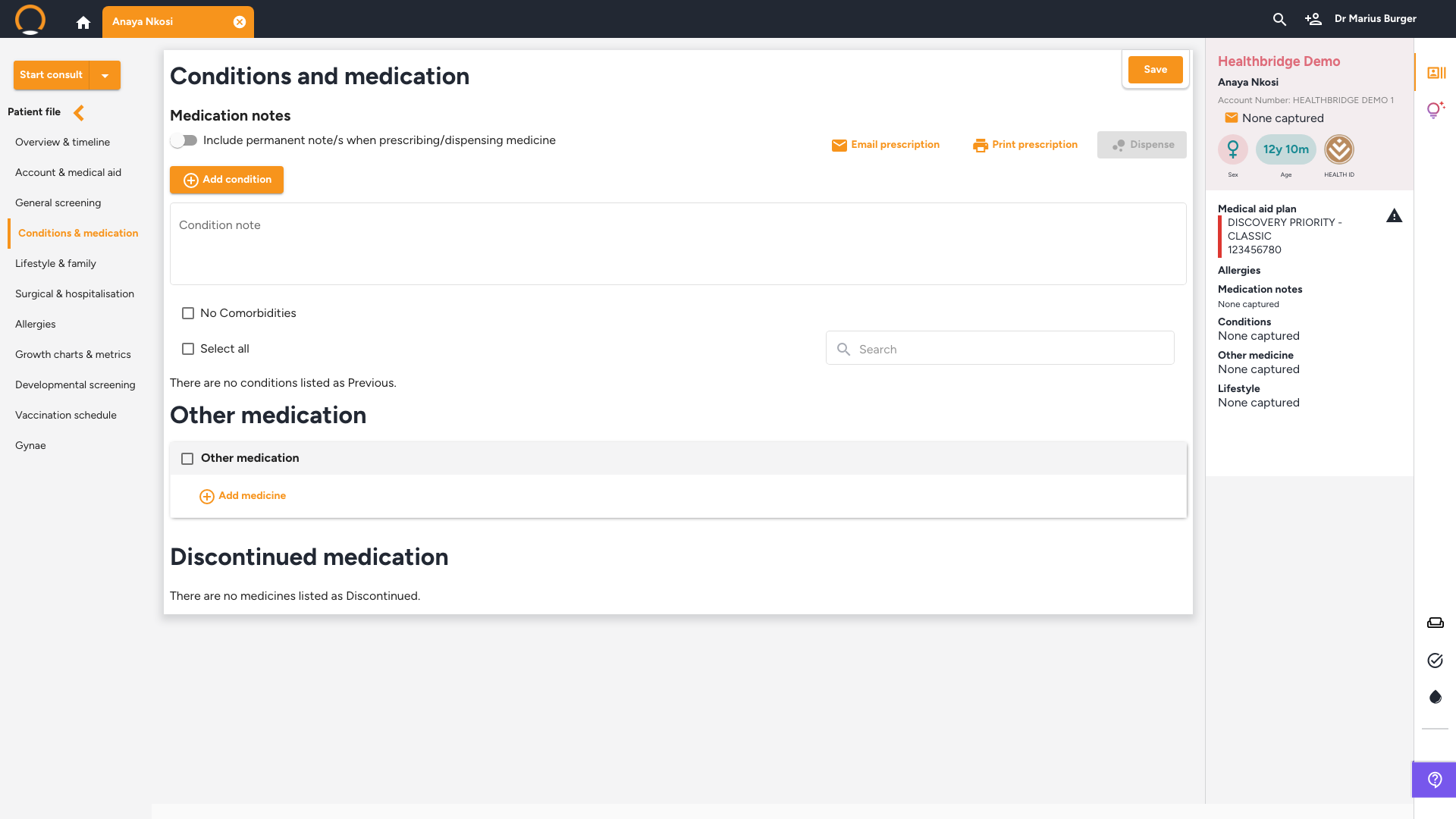
Any recorded allergies appear as a red banner at the top of this page. Below it:
- Chronic conditions, diagnosed conditions, with linked medication, an ICD-10 code, and a toggle to flag the condition as chronic or a Prescribed Minimum Benefit (PMB) with the patient's medical aid.
- Previous conditions, earlier conditions still relevant to current treatment.
- Other medication, acute medication or supplements, also taggable as chronic/PMB.
- Discontinued, any medication marked as discontinued from the sections above.
5. Lifestyle & family
Location: Patient file › left menu
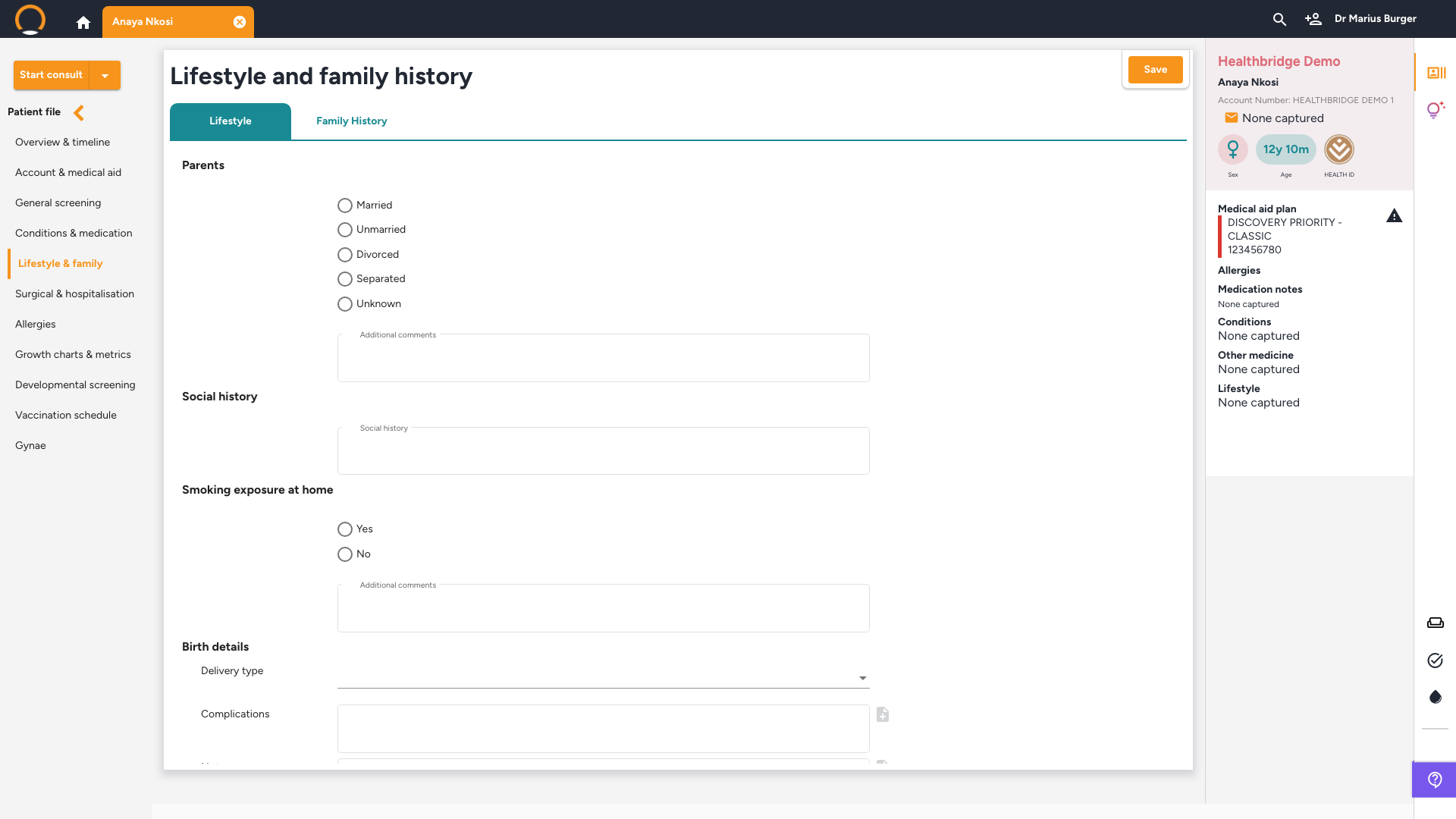
Two sub-tabs: 'Lifestyle' covers smoking, alcohol, recreational drug use, stress, activity level, and diet. 'Family History' lists heritable conditions with Mother/Father tags per disease. For patients 12 and younger, this section also includes birth details.
6. Surgical & hospitalisation
Location: Patient file › left menu
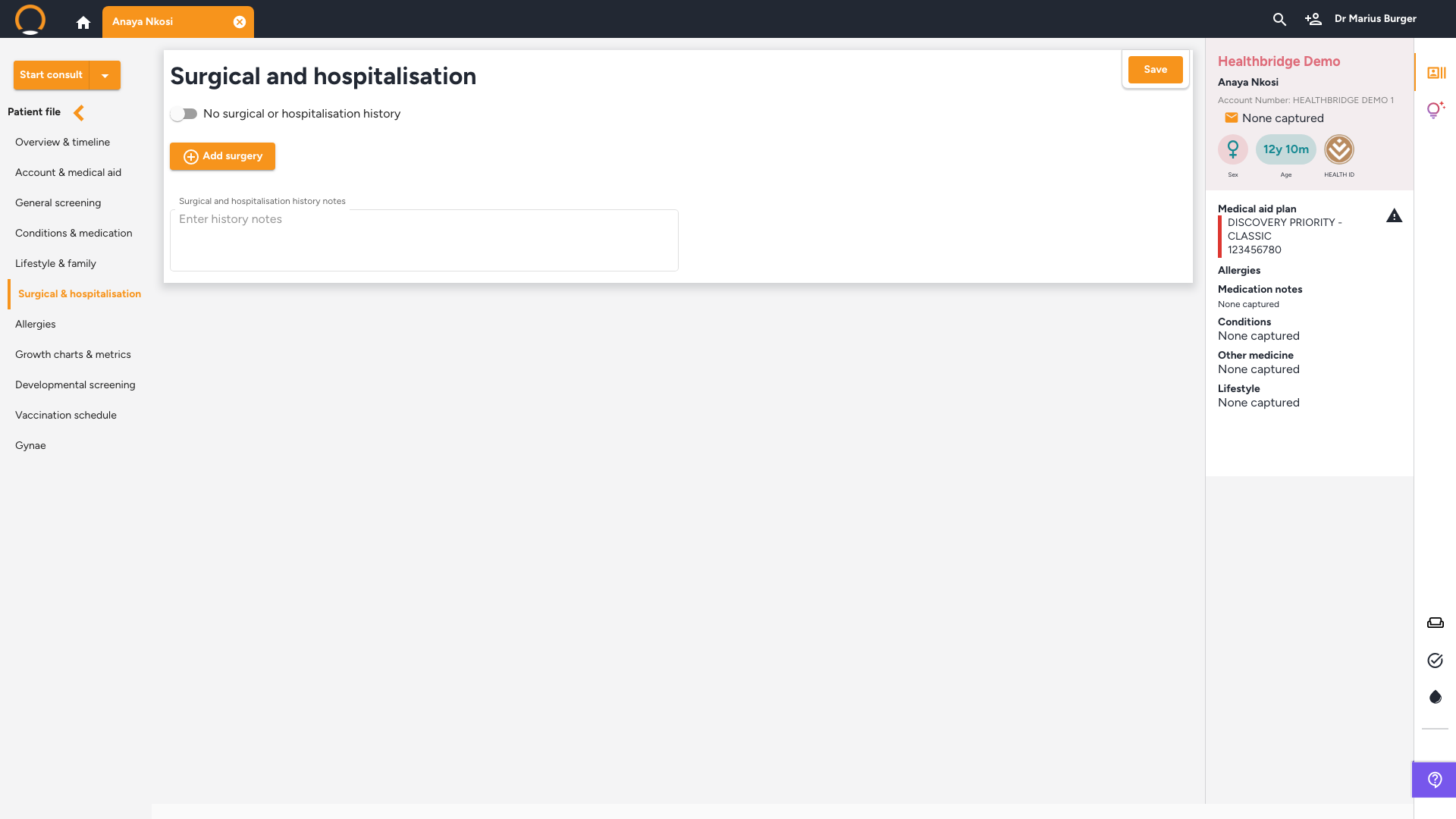
Lists any surgical procedures and hospital admissions on record. Toggle 'No surgical or hospitalisation history' if none apply, or click 'Add surgery' to record one.
7. Allergies
Location: Patient file › left menu
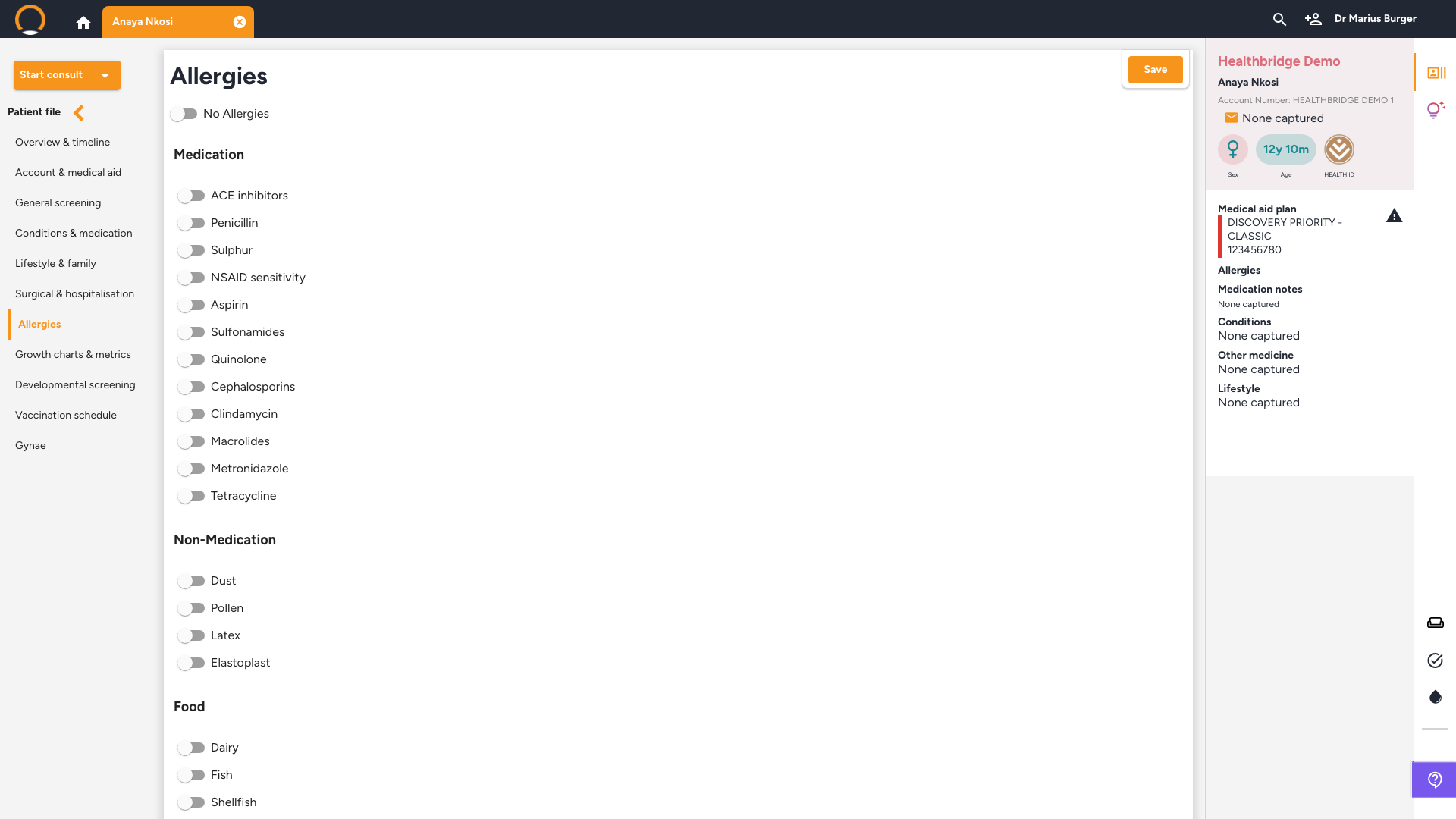
Broken into Medication, Non-Medication, and Food allergies. Toggle on any that apply and set a severity of Severe, Moderate, or Mild. Anything recorded here surfaces automatically as a warning banner elsewhere, for example on the Medicine tab and printed prescriptions.
8. Vitals & metrics (adult patients)
Location: Patient file › left menu
Record and track vital statistics, blood pressure, weight, BMI, waist circumference, and more, plus HIV-related metrics where relevant. Switch to the 'Charts' sub-tab to see each metric graphed over time.
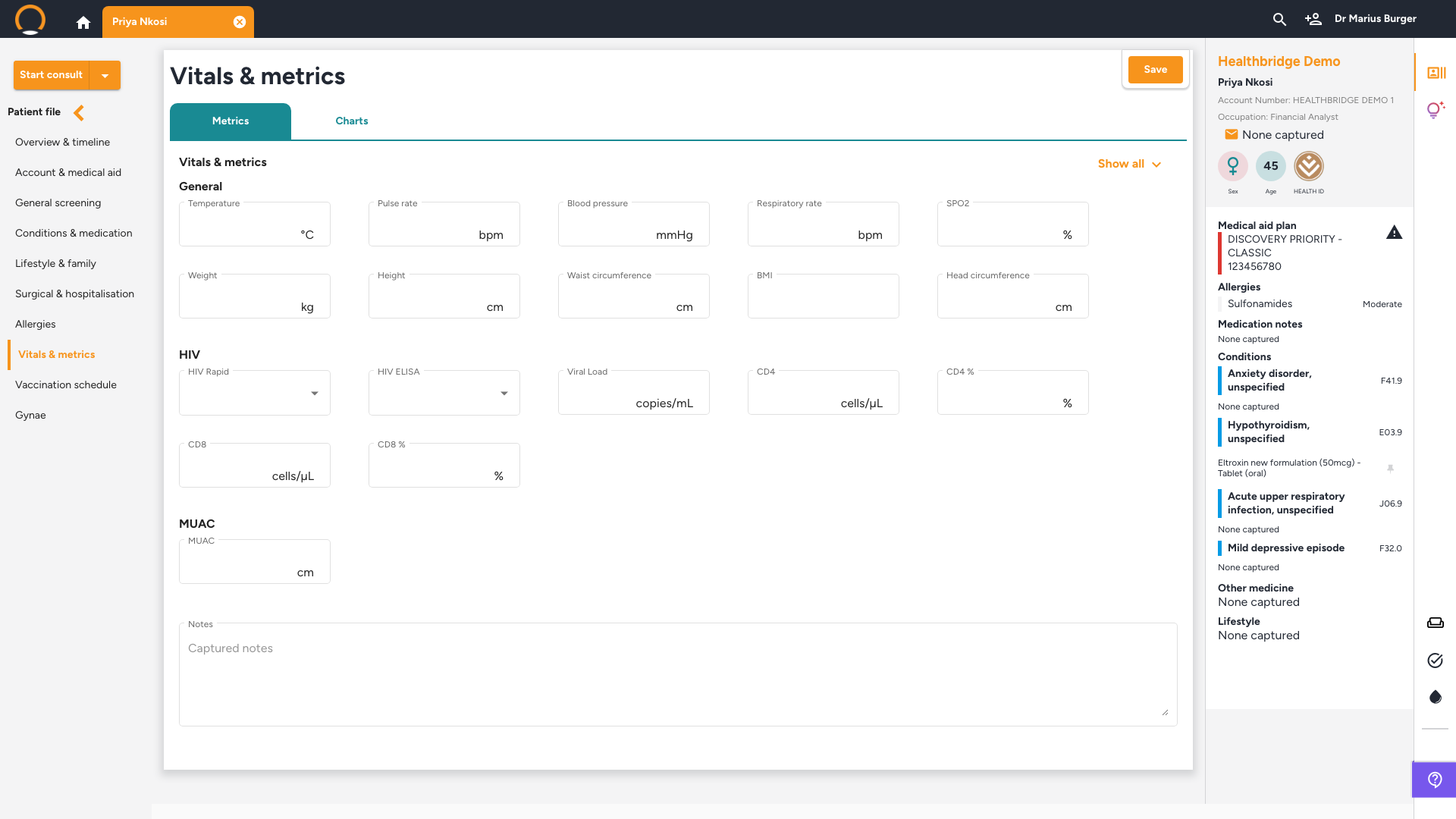
Age-specific: For younger patients, this menu item is replaced by 'Growth charts & metrics' below, and a separate 'Developmental screening' section also appears.
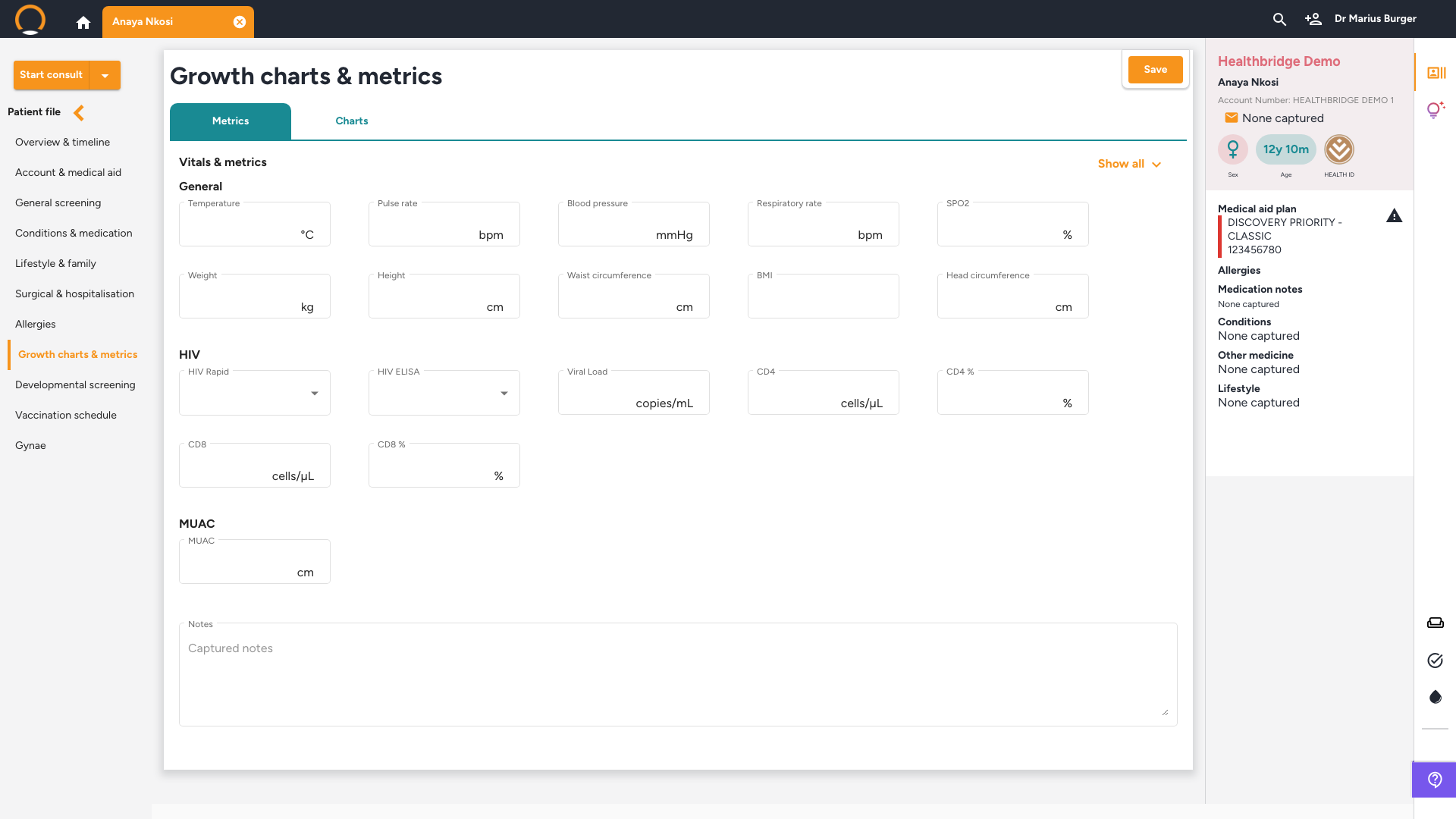
9. Growth charts & metrics (younger patients)
Location: Patient file › left menu
The same vitals fields as the adult version, plus two paediatric-specific fields: Head circumference and MUAC (mid-upper arm circumference, used to screen for malnutrition). The 'Charts' sub-tab plots each metric against standard growth curves for the patient's age.
10. Developmental screening (younger patients)
Location: Patient file › left menu
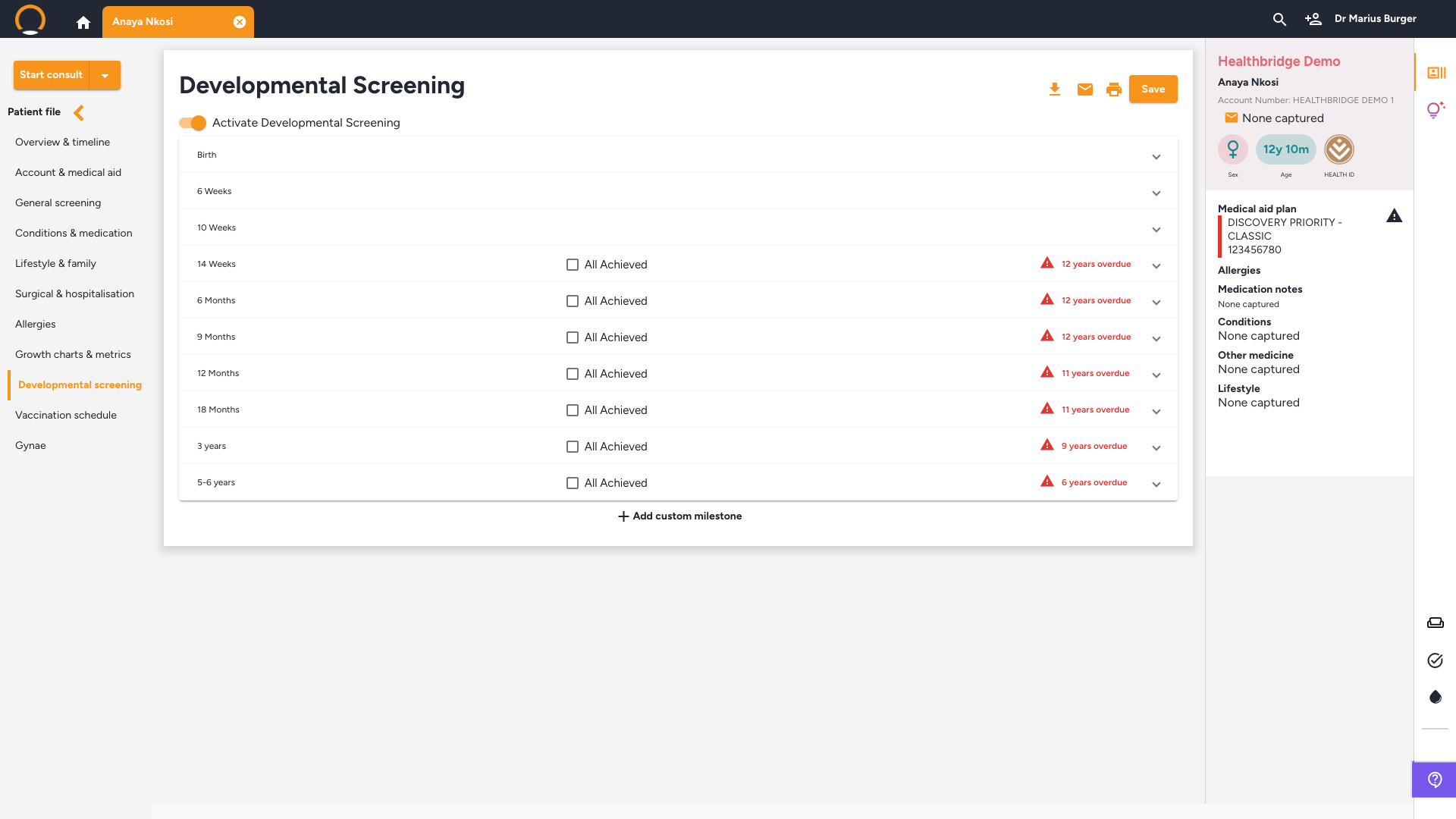
A milestone checklist by age (Birth through 5-6 years). Toggle 'Activate Developmental Screening' on, then tick 'All Achieved' for each age band as milestones are confirmed. Overdue bands are flagged automatically.
11. Vaccination schedule
Location: Patient file › left menu
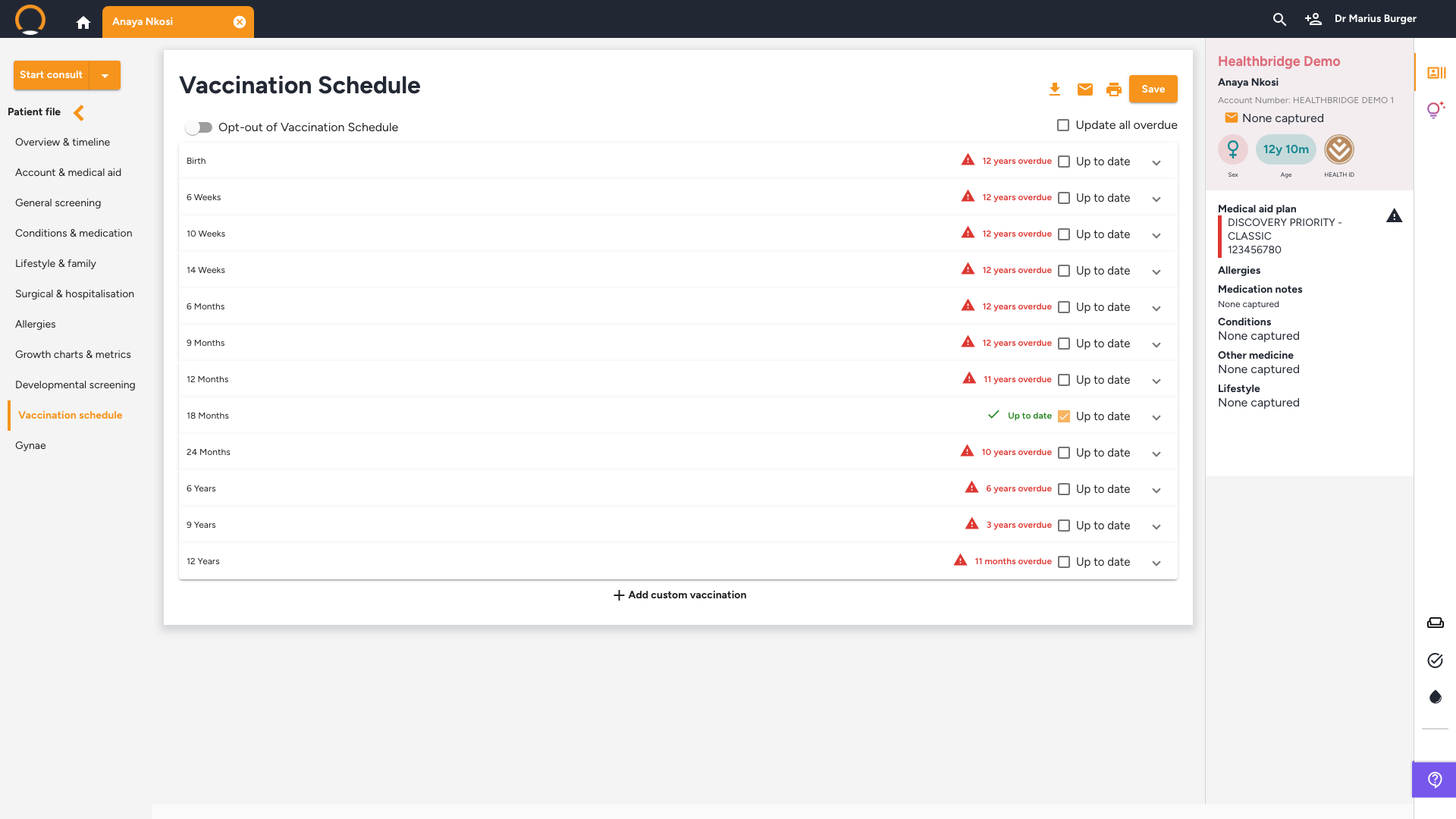
Toggle 'Opt-out of Vaccination Schedule' if it doesn't apply to this patient. Otherwise the schedule tracks each age band, flags overdue vaccinations, and lets you tick 'Up to date' once given. Use the download, email, and print icons at the top to share the schedule, or 'Add custom vaccination' for one outside the standard schedule.
12. Gynae (female patients)
Location: Patient file › left menu
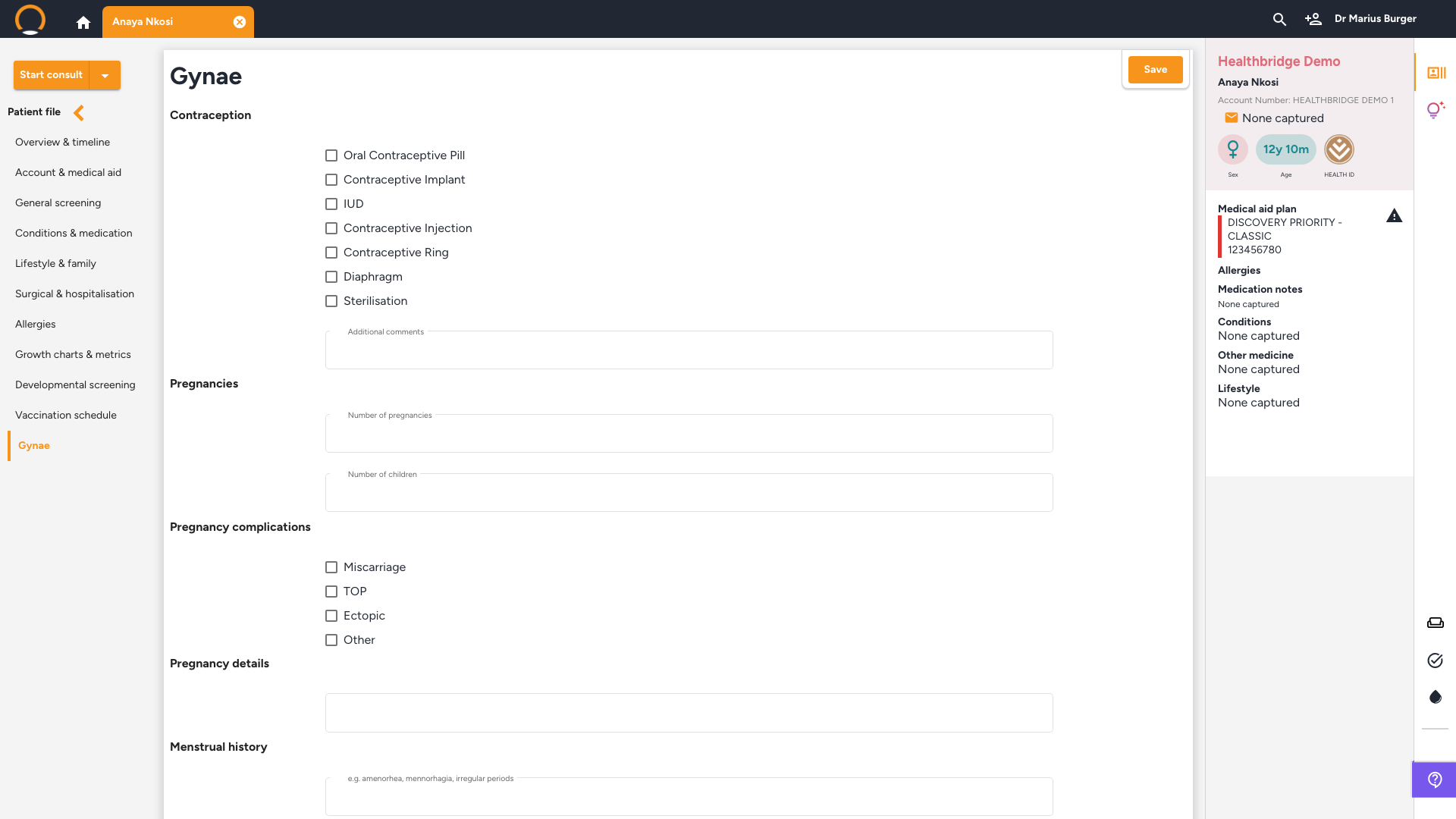
A template for recording women's health information: Contraception in use, Pregnancies and any Pregnancy complications, and Menstrual history.
Frequently asked
Q: Why do I see 'Growth charts & metrics' and 'Developmental screening' instead of 'Vitals & metrics'?
Healthbridge Clinical tailors the patient file menu to the patient's age. Younger patients see growth-tracking and developmental screening sections in place of the standard adult vitals section.
Q: Why does 'Gynae' appear for some patients and not others?
The menu is tailored to sex as well as age. Female patients get the additional 'Gynae' section for recording contraception, pregnancy, and menstrual history; male patients don't see it at all.
Q: Where do I add a screening test that isn't already listed?
On the General screening section, click '+ Add' to select a test that isn't shown by default, or add a fully custom test or metric you'd like to track for that patient.
Q: How do I discontinue a medication?
On the Conditions & medication section, use the discontinue action next to the medication line item. It then moves into the 'Discontinued' section for that patient.