
Provider Changes and Their Effects on the Consult Window
Provider Changes and Their Effects on the Consult Window
What: Two groups of toggles on the Settings page ('Consultation UI Settings' and 'Advanced consult settings') that control which tabs and fields appear in every consultation you open.
Why: These are provider-level preferences, not per-patient options, switching one on or off changes what every future consult window looks like for you, starting immediately.
When: Worth reviewing once during setup, and again any time a consult tab seems to be missing or a step feels unnecessary for how you work.
1. Where to find these toggles
Location: Provider File › Settings › General
Click your name in the top-right corner to open the Provider File, then click 'Settings' in the left menu. The two toggle groups covered below sit side by side under 'General', right at the top of the page.
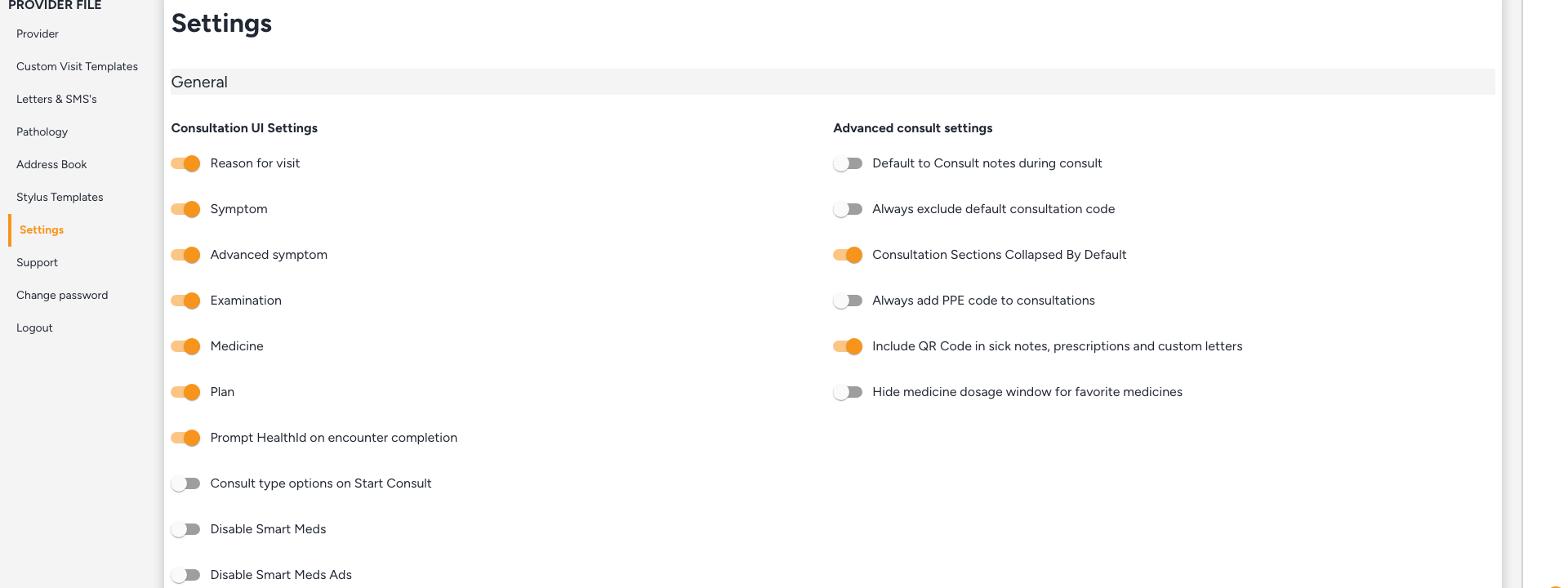
Consultation UI Settings
Controls which tabs and entry fields appear inside every consult window.
Setting | Effect on the consult window |
|---|---|
Reason for visit | Adds a mandatory field to specify the visit reason at the start of a consult. |
Symptom | Adds a simple symptom entry field. |
Advanced symptom | Allows more detailed symptom input, including duration and severity. |
Examination | Adds an Examination tab to capture vital signs and examination metrics. |
Medicine | Allows prescribing and dispensing medicines directly in the consult. |
Plan | Activates the Plan tab, where doctors can issue letters, sick notes, and follow-ups. |
Prompt HealthId on encounter completion | Requires a Health ID prompt before closing a consult. |
Consult type options on Start Consult | Displays multiple consult types (e.g. general checkup, follow-up) when starting a consult. |
Disable Smart Meds | Removes SmartMeds suggestions, requiring manual medicine selection. |
Disable Smart Meds Ads | Hides SmartMeds' sponsored medicine suggestions specifically, while leaving its regular suggestions on. |
Advanced consult settings
Finer-grained behaviour: what the consult opens into, and what gets added automatically.
Setting | Effect on the consult window |
|---|---|
Default to Consult notes during consult | Opens directly into Consult Notes, skipping the other tabs. |
Always exclude default consultation code | Removes the auto-populated consultation billing code, requiring manual entry. |
Consultation Sections Collapsed By Default | Collapses all consultation sections, so you expand only the ones you need. |
Always add PPE code to consultations | Automatically includes a PPE billing code in every consultation. |
Include QR Code in sick notes, prescriptions and custom letters | Every clinical PDF you download or generate already includes the authentication QR code by default, so this toggle rarely needs attention. See Add or Remove Watermarks on Documents for more on the QR code and per-document watermark settings. |
Hide medicine dosage window for favorite medicines | Skips the dosage selection pop-up when prescribing a favourite medicine, using its saved values instead. |
Note: These two toggle groups are the only settings that affect the consult window. There's no separate "Enable Clinical Notes tab" toggle, and no toggle for medicine-interaction checking.